
The Denver Post’s analysis of the positions of Denver mayor candidates on education reform put Michael Hancock and Chris Romer in the top position. Carol Boigon had more of a hands-off approach and Doug Linkhart seemed to shy away due to union aspects. James Mejia, who knows education from his school board and early childcare experiences, frames the reform issues along the lines of the reform opponents who claim minority representation is insufficient.
Monday, March 28, 2011


Friday, March 25, 2011
Denver Metro Area State’s Population Hub
The Denver metro area continues to have slightly more than half (55%) of the state’s population. It has historically been the state’s population hub (54% in 1960). The region’s growth rate of 16 percent the last decade was one percent below the state average of 17 percent. The state’s other regions had slightly higher growth rates, but not enough to challenge the metro area’s dominance – the South (18%) and North (28%) Front Ranges and along the I-70 corridor on the Western Slope (20%).

Denver has been the region’s dominant county, and is still the largest – it held 47% of the region’s population in 1960, and now represents 22 percent. In fact, Denver had 28 percent of the state’s entire population in 1960. It is now 12 percent of the state. Although that decline reflects the long-term population trends for core cities and counties around the county, Denver has done better than most and, in fact, grew by 45,000 residents from 2000. Among the major trends observable from the 2010 census data are:
• The South Metro area gained the most people during the first decade of the new century. More than half of Arapahoe’s growth, which paced the state (17% growth in both state and county), was in Aurora, and more than half of the city’s population is Hispanic, black and Asian Pacific Islanders.
• Although Denver’s growth of 45,000 (8%) was less than the regional average, it represents the city’s continued vitality. Denver has increased by 133,000 residents since the 1990 census (28% increase). Also, along with being an arrival city, much of the growth was from metro residents moving into the city from the suburbs to be close to a vibrant city center and to reduce transportation burdens.
• Douglas County growth slowed dramatically at the end of the decade due to the weak economy, causing a major housing bust. Adams County and the north suburbs began a slower, but steadier growth trend in its western suburbs and in smaller cities and towns in the north. The county has more room to grow into good transportation access and considerable water.
• Boulder County lost Broomfield during the decade as the city became an independent city and county. Boulder’s anti-growth policies were successful as the county had the smallest population increase in the area– 3,277 residents (1%).
• Jefferson County has had little growth since the mid-1990s when it appeared to be surging to become the state’s largest county. Now, it has fallen behind Arapahoe County by 40,000 residents. Two of its largest cities – Lakewood and Wheat Ridge – lost residents.
Wednesday, March 23, 2011
Front Range Counties to Dominate Colorado’s Population and Politics
Colorado grew by more than 700,000 people since 2000, and it was mostly distributed along the Front Range. Eighty-two percent of Colorado’s population is spread along the Front Range, with more than two-thirds of it in the six-county metro area.

The North Front Range has about a tenth of the state’s population, with Weld County growing by 40 percent (state’s second fastest with 71,889 new residents). The South Metro area of El Paso and Pueblo counties have 16 percent of the state’s population, with most of it in the Colorado Springs area, which grew by 105,000, helped by a growing military presence.
Within the Denver Metro area, the north and south suburbs continue to grow rapidly (Douglas County held the state record of a 62% increase), and the area’s core city, Denver, added 45,000 residents.
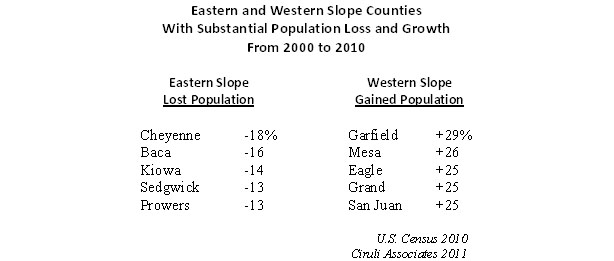
There were a number of counties on the Eastern Slope that lost population the last 10 years, whereas the Western Slope had many counties with large increases, most along the I-70 corridor.
Monday, March 21, 2011
Wisconsin Conflict in Colorado?
A full-scale labor war is less likely in Colorado than Wisconsin. Colorado is a modified right-to-work state with low levels of private sector unionization. That is not to say business activists and labor leaders would not try to change the balance of power in Colorado if they had a chance. Rather, the partisan balance at the State Capitol makes legislation weakening or strengthening the respective positions of labor and business unlikely.
Labor wars broke out in 2007 when Democrats took over the governorship and had majorities in both houses of the legislature. Although the short-term impact was to strengthen state employee unionization, the ultimate effect was to contribute to Gov. Bill Ritter’s political troubles and launch an expensive ballot war in 2008 over right-to-work, which left the state’s labor/business balance of power unchanged.
Although conservatives would like to challenge public sector unions, especially the teachers union, at the moment cutting K-12 budgets is harming the teachers union more than changes in collective bargaining could. Anti-union interests are also benefiting from the well established, including among liberal urban Democrats, school reform movement with its preference for independent charter schools and hostility to teacher seniority and job protection rules. The most aggressive manifestation of the momentum of the reform movement is a voucher system’s recent boost in Douglas County.
Because of the ease of access to the Colorado ballot, the battle over the size and expense of the state’s public sector will likely be waged around questions of new taxes in 2011. But, creative political operatives will likely think up new measures for voters to consider if not this year, then 2012. Questions related to the political influence and the budgeting impact of the public sector will likely dominate this decade as the recession throws public revenue and expenditures in sharp relief.
Labor wars broke out in 2007 when Democrats took over the governorship and had majorities in both houses of the legislature. Although the short-term impact was to strengthen state employee unionization, the ultimate effect was to contribute to Gov. Bill Ritter’s political troubles and launch an expensive ballot war in 2008 over right-to-work, which left the state’s labor/business balance of power unchanged.
Although conservatives would like to challenge public sector unions, especially the teachers union, at the moment cutting K-12 budgets is harming the teachers union more than changes in collective bargaining could. Anti-union interests are also benefiting from the well established, including among liberal urban Democrats, school reform movement with its preference for independent charter schools and hostility to teacher seniority and job protection rules. The most aggressive manifestation of the momentum of the reform movement is a voucher system’s recent boost in Douglas County.
Because of the ease of access to the Colorado ballot, the battle over the size and expense of the state’s public sector will likely be waged around questions of new taxes in 2011. But, creative political operatives will likely think up new measures for voters to consider if not this year, then 2012. Questions related to the political influence and the budgeting impact of the public sector will likely dominate this decade as the recession throws public revenue and expenditures in sharp relief.
Friday, March 18, 2011
Hancock Campaign in Crisis
Voting for a $10,000 pay raise four weeks out of the start of the Denver mayor’s race was a risky act ($5,000 for council members). Although it was not a surprise Doug Linkhart would support it, one of the City Council’s strongest liberals, it caused a major controversy in Councilman Michael Hancock’s campaign. Hancock, a smart and usually careful politician, who was running a strong second in the mayoral money race, caused a firestorm of criticism within his campaign and provided his opponents considerable ammunition for the final weeks of the campaigning and the runoff if he should make it.
The salary issue became a needed reprieve for mayoral campaign watchers from a mostly lackluster and issueless race. How Hancock handles the issue may decide if he remains a leading candidate.
See Denver Post and 9News articles:
Pay-raise issue divides mayoral field
Four of 6 leading Denver mayoral candidates rip council vote to raise officials’ salaries
Denver mayoral candidates would return raises
The salary issue became a needed reprieve for mayoral campaign watchers from a mostly lackluster and issueless race. How Hancock handles the issue may decide if he remains a leading candidate.
See Denver Post and 9News articles:
Pay-raise issue divides mayoral field
Four of 6 leading Denver mayoral candidates rip council vote to raise officials’ salaries
Denver mayoral candidates would return raises
Thursday, March 17, 2011
Candidates Begin the Debate – March 2 Denver Petroleum Club/Denver Athletic Club Forum
The top six candidates for mayor of Denver had their answers down to two minutes on a full range of topics at the DAC/Petroleum Club forum on March 2. They all had spent considerable time thinking about economic development and had the most passion for fixing education – both topics where Denver mayors have only a few small carrots and sticks.
Where they actually could make a difference, such as in police personnel or procedures or the structure of Denver’s revenue and spending, they were more cautious and less animated.
But, one of six will be mayor, and the top four or five will receive 90 percent of the vote. Ten candidates made the ballot. So, unfortunately, for the next month, many forums will be filled with pleasant, but irrelevant, conversation from several candidates with a few supporters, but no chance.
Can one of these candidates win the election on May 3 without a runoff? If the race is measured by money, Romer accumulated more than twice the amount of any other candidate in February. But money will likely only get him into a frontrunner position, not necessarily the fourth floor. And, being the frontrunner makes Romer the leading target for the next two months.
See articles:
Denver Post: Denver Mayoral candidates mean business during forum
Colorado Statesman: Candidates for Denver mayor get down to business
Where they actually could make a difference, such as in police personnel or procedures or the structure of Denver’s revenue and spending, they were more cautious and less animated.
But, one of six will be mayor, and the top four or five will receive 90 percent of the vote. Ten candidates made the ballot. So, unfortunately, for the next month, many forums will be filled with pleasant, but irrelevant, conversation from several candidates with a few supporters, but no chance.
Top Candidates
Carol Boigon
Michael Hancock
Doug Linkhart
James Mejia
Chris Romer
Theresa Spahn
Can one of these candidates win the election on May 3 without a runoff? If the race is measured by money, Romer accumulated more than twice the amount of any other candidate in February. But money will likely only get him into a frontrunner position, not necessarily the fourth floor. And, being the frontrunner makes Romer the leading target for the next two months.
See articles:
Denver Post: Denver Mayoral candidates mean business during forum
Colorado Statesman: Candidates for Denver mayor get down to business
Wednesday, March 16, 2011
Coloradans Can’t Balance a Budget
The main message from the recent Denver Post/9 News sponsored effort to have interested citizens balance a budget is that they can’t make any cuts of significance. Their most enthusiastic choice was for a steeply graduated billion dollar plus increase in the state income tax.
After a 40-minute exercise in using hand-held polling devises, the assembled audience, populated with a high percentage of liberal interest groups and media types, cut $100,000,000 out of the state’s billion-dollar deficit and mostly ignored the Governor’s recommendations, for example, for a quarter billion dollar cut in K-12 spending.
However, this audience is not much different than the public at large in their reluctance to cut anything they value for reasons of social equality, sympathy or pure self-interest. Repeated national polls show the public wants a balanced budget and claims to prefer cuts over higher taxes and borrowing, but refuses to endorse any serious reductions in entitlements or defense, and likes the concept of taxing high-income individuals or profitable corporations.
The latest Gallup poll on state budget balancing shows the public claims to prefer balancing the budget with cuts, not taxes or borrowing. But, if given a list of items that reducing will make the biggest impact – Social Security and Medicare – voters cringe and can’t do it.

Notice the Wisconsin scenario of limiting bargaining rights of state employee unions is very polarizing.
As the two members of the Colorado Joint Budget Committee said, they don’t have a choice. They must balance the budget by May. And, they can’t raise taxes without a vote of the public. But, that couldn’t take place until November, and if passed, wouldn’t start to take effect until 2012.
After a 40-minute exercise in using hand-held polling devises, the assembled audience, populated with a high percentage of liberal interest groups and media types, cut $100,000,000 out of the state’s billion-dollar deficit and mostly ignored the Governor’s recommendations, for example, for a quarter billion dollar cut in K-12 spending.
However, this audience is not much different than the public at large in their reluctance to cut anything they value for reasons of social equality, sympathy or pure self-interest. Repeated national polls show the public wants a balanced budget and claims to prefer cuts over higher taxes and borrowing, but refuses to endorse any serious reductions in entitlements or defense, and likes the concept of taxing high-income individuals or profitable corporations.
The latest Gallup poll on state budget balancing shows the public claims to prefer balancing the budget with cuts, not taxes or borrowing. But, if given a list of items that reducing will make the biggest impact – Social Security and Medicare – voters cringe and can’t do it.

Notice the Wisconsin scenario of limiting bargaining rights of state employee unions is very polarizing.
As the two members of the Colorado Joint Budget Committee said, they don’t have a choice. They must balance the budget by May. And, they can’t raise taxes without a vote of the public. But, that couldn’t take place until November, and if passed, wouldn’t start to take effect until 2012.
Subscribe to:
Posts (Atom)