Doubt is gone. Colorado is sapphire blue. The red tide did not show up and Republicans must decide what’s next. On KOA’s morning news (11-9-22), Marty Lenz and Floyd Ciruli examine the results and political changes the day after.


Doubt is gone. Colorado is sapphire blue. The red tide did not show up and Republicans must decide what’s next. On KOA’s morning news (11-9-22), Marty Lenz and Floyd Ciruli examine the results and political changes the day after.
On the Monday before the election, KOA Morning News anchor Marty Lenz and Floyd Ciruli (11-7-22) reviewed the early returns and pointed out unaffiliated voters were the largest block of voters and will decide the election.
I asked in a November 2 blog post if Colorado Republicans would best the 45 percent high they won in statewide races in 2018--answer, No. Jared Polis won the governorship in 2018 by 10 points. This year, Polis won by 19 points.
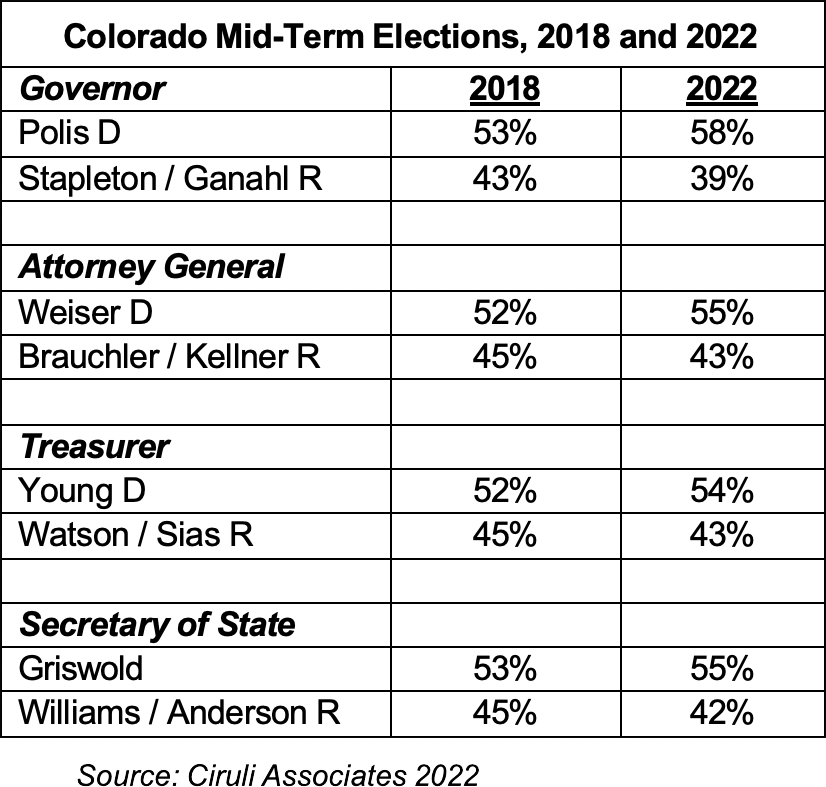
Along with the state sweep, Republicans were beaten in the marquee Federal competitions. Senator Michael Bennet was reelected by 15 points and the new 8th Congressional district rated leaning Republican, was won by the Democrats in a close race with more than 1500 votes. The seemingly safe district of controversial Congressperson Lauren Boebert was held by only 500 votes.
RELATED: Will Colorado Republicans Win More Than 45% of the Vote?The turnout in the 2018 midterm was 76 percent of voters, considered very high for Colorado and nationally. More than 2,581,000 of 3,380,000 registered active voters returned ballots.
As of November 14, 2,557,000 voters turned in ballots that had been counted or less than the total returned in 2018. It equals 67 percent of the 3,825,000 registered voters in the system, a considerable falloff in turnout from 2018.

After a month of leading in many polls, Democrats in early October saw significant erosion of their position. Polling results began to show a trend back toward Republican candidates and preference in the generic ballot test. A Democratic boost based on the Supreme Court’s Dobbs decision was short lived. A shift of 4 points was measured in the Monmouth and Siena/New York Times polls toward the Republicans by mid-October. It was noticeable in a host of senate and governors’ races in competitive states such as Wisconsin, Pennsylvania, North Carolina, and Georgia. Analysts attributed the shift to a variety of factors such as the salience of inflation in the media, an unpopular President, and importantly, the normal return to fundamentals of the midterm voters.

In the West, Republicans also began to improve their positions during October in Arizona, Nevada, Oregon and Washington, but late polls show mostly close races. Nevada is now a toss-up state, with Republicans in a slight lead but both the governor and senate race in the margin of error (2 points on November 4). In Arizona, the senate race has grown competitive with Mark Kelly having only a 1-point lead and Kari Lake, the Republican gubernatorial candidate, is now up 2 points. Her strengths may be affecting the senate race. Although Democrat Patty Murray may still win her senate race, the numbers have tightened, and in Oregon, Republican Christine Drazan is ahead in a three-party race in a Blue state.
As of Friday, November 4, four days out from the midterm election, a total of 1,099,847 ballots have been returned and unaffiliated voters are more than 4 points ahead of each of the partisan camps.
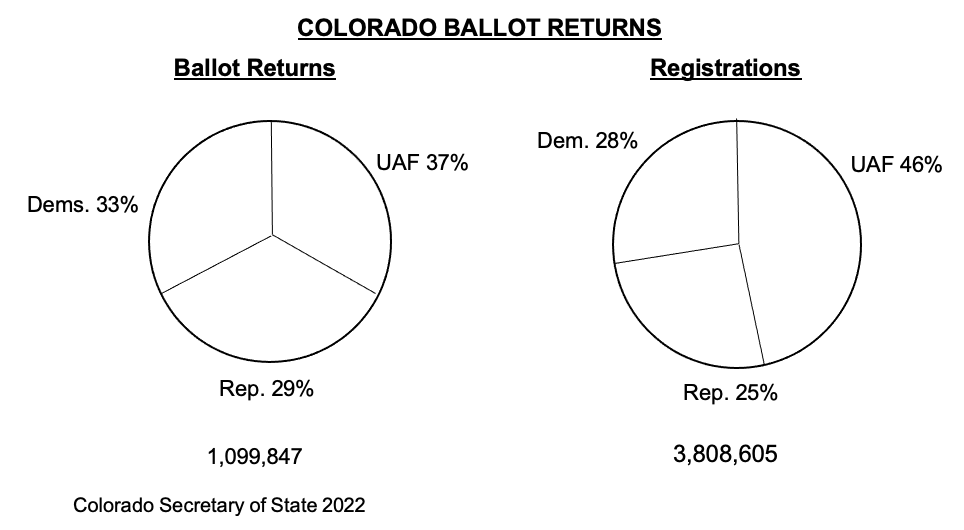
Unaffiliated voter registration began surging the last ten years during Colorado decade of rapid growth. It now is more than 700,000 votes ahead of each of the partisan parties. Registration is 46 percent of voters, a jump from 38 percent in 2018. Democrats are 28 percent, Republicans 25 percent.
Both Democratic and Republican governors are ahead of the competition in battleground states where their partisan senate candidates are in difficult fights. Having a strong partisan ally at the top of the ticket has helped many partisans below. Governors tend to be the best known and most influential partisans in a state.
In Pennsylvania—John Fetterman is now only a point ahead, but the Democratic gubernatorial candidate—Josh Shapiro, is up 11. Mike DeWine, popular Republican Ohio Governor is helping Senate candidate J.D. Vance. On the Republican side Brian Kemp in Georgia is up 8 and his fellow partisan senate candidate Herschel Walker has inched ahead 1. Kati Lake in Arizona has moved ahead 2 and the Democrat Mark Kelly, has slipped back to 1 point. In Colorado, Jared Polis has been up more than 10 percent during the campaign and Michael Bennet is holding 5 points opposite a strong opponent. The expected massive victories of Gavin Newsom in California, Greg Abbot in Texas and Ron DeSantis are all helping their respective states partisan tickets.

